
 Let me start off by saying that this year's Oscar show was the best I can remember, for one reason alone: Hollywood decided to shake things up. They trimmed the fat from past ceremonies (individual performances of Best Song nominees, clips from Best Picture nominees, and a quaint but dull appearance from the director of the Academy) and replaced it with new, lively, and eyecatching material.
 The set design was astonishing in its combination of classic elegance and undeniably modern technical wizardry; the stage, framed by a luminous crystal curtain and etched in gorgeous lines of deep blue, worked seamlessly with gravity defying screens that seemed to appear from nowhere. These screens were particularly breathtaking during the in memoriam retrospective, when multiple fragments of remarkable careers appeared simultaneously, and in the enormous portraits of the iconic actors who passed on their tradition to this year's nominees. I particularly admired the attention they paid to individuals this year, as each one of the nominees was singled out for their achievements. The Oscars had a much more personal feel this year, a qualtiy perhaps best encapsulated by the minimized space between the seats and the stage.
 Perhaps the most refreshing change made to the Oscars this year was the choice of Hugh Jackman as host--a break from the tradition of giving the role to established comedians. The funny men and women of past shows often struggled to make the enormous ceremony intimate; Jackman broke the mold almost immediately by grabbing Anne Hathaway from the first row for a funny and sweet duet. The premise of the last-minute DIY-style opening was refreshing, free of pretense, and often hilarious. Jackman's talents as a performer were a pitch-perfect match for an awards show dedicated to the celebration of Hollywood's flamboyant tradition. The set pieces alternated between the grandiose and the self-consciously homemade, a fitting tribute to the broad range of production styles that make the movies so interesting.
 While the visuals at the Oscars were captivating this year, the nominees in the major categories were not. Danny Boyle's tragic proclivity for wrapping up his initially refreshing movies with happy little endings paid off against the backdrop of our depressing economic situation, and Slumdog Millionaire ran away with eight statues, including honors for Best Picture, Director, and Adapted Screenplay. Sean Penn got the nod for Best Actor, arguably robbing Mickey Rourke but really fleecing Frank Langella, whose turn as Richard Nixon was mesmerizing in the otherwise lifeless Frost/Nixon. Kate Winslet left the stage with a Best Actress Oscar as well as an award for Most Predictable Award Ever. Thus, the major awards went to all of the expected winners, few of whom would have had a chance in stronger years. (Please pardon my pessimistic tone here, I was less than pleased with the major nominees this year.)
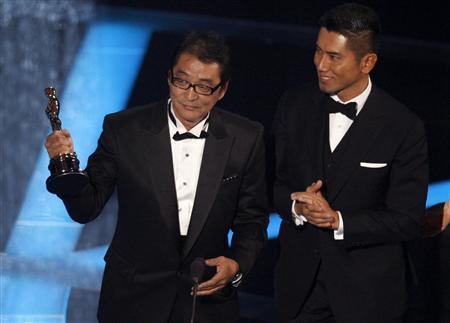 The only real surprise of the night occurred in the wonderfully strong Best Foreign Film category, as Departures from Japan beat out an outstanding Waltz With Bashir and utterly superb The Class (read my review here); I was certain that Waltz would have won despite my greater affinity for The Class, but this huge upset launched Departures to the top of my must-see list.
All in all, the Oscars was a terrific show despite the relatively weak films honored there. What did you all think of the ceremony and winners? Hit me up in the comments. Here's hoping that next year's best films prove better than these.
Photos Courtesy of The New York Times
Monday, February 23, 2009
Great Show, Weak Winners

Sunday, February 22, 2009
Strombolian Films
 I want to share a terrific post from Girish Shambu, whose blog Girish is a consistently excellent place for intelligent and accessible writing about film, about movies that defy easy understanding. Check it out:
Wong Kar-wai's Chungking Express (1994) was, for me, a key Strombolian film. The first time I watched it, I remember this: I reached for a pillow and hurled it at the screen! It was at the very moment that Faye Wong put on the Mamas and the Papas' "California Dreamin'" for the umpteenth time. The film seemed to be caught in an infinite loop, uninterested in moving forward. At the time I had been discovering the pleasures of character-driven cinema--like Howard Hawks and Eric Rohmer--and in comparison, Wong's film seemed to care not a whit about 'advancing' plot or character. The reigning mood was one of stasis.
A few years later, when I revisited the film, I was led to an important self-realization: that I had privileged and held as 'natural' a certain economy between form and content in a film work. According to this economy, matters of form and style--composition, cutting, rhythm, color, texture, movement, mood--had a specific function. They served something 'higher': narrative and character. Of course, this classicist criterion for judging an artwork seems embarrassingly restrictive to me today--but there was a time when I applied its yardstick to every film that came along. In fact, I suspect that such an economy between form and content is widely held as the norm by the viewing public at large today.
The content of Chungking Express might be about stasis, but its form--I realized upon second viewing--is all about movement! The film burns with stylistic bravura, most remarkably Wong's signature stretch printing of action which smears colors and shapes voluptuously across the screen. The French critic Jean-Marc Lalanne has written:
"In cutting and recomposition through editing each movement of the actors, the mise-en-scène invents a kind of 'ballet mécanique' of human movements, a choreography in which each gesture becomes abstract, loses its functionality in favor of a purely musical value."
Brenez's notion of Strombolian films holds at least three lessons: (1) A viewing experience is often contingent upon where we happen to be situated--in our lives at a certain point in time--in relation to a work and its aesthetic; (2) It is important to revisit films that frustrated or disappointed us the first time around, and do so with a willingness--even eagerness--to struggle with the work while we simultaneously de-emphasize evaluative judgment for a little while; and (3) The resistance we encounter from an artwork can be put to great and productive use.
I'm wondering: What are your experiences of films that you weren't ready for when you first encountered them? Please feel free to share.
Friday, February 20, 2009
Film Comment Selects Opening Night
 Hey movie lovers! I've been working at the Film Society of Lincoln Center for a little while now, and they've just sent me an invite that they'd like my friends (read: YOU) to get! It's the opening night of their latest series, the Film Comment Selects, which is TONIGHT. You should come, and definitely check out the rest of this cool series of little-known films selected by the wise people at Film Comment.
Friday, February 20th, 2009
6:30pm Screening of Paradise
8:00pm Talkback with Director Michael Almereyda
& Author Jonathan Letham
Afterparty to follow
The Walter Reade Theater
165 West 65th Street
Please RSVP to Rob Mooney at rmooney@filmlinc.com if you would like to attend.
PARADISE
Michael Almereyda is best known for his hip, update of HAMLET, with Ethan Hawke, and his black-and-white vampire film NADJA. PARADISE continues his recent foray into documentary that began with WILLIAM EGGLESTON IN THE REAL WORLD. Like all of Almereyda's films, PARADISE is a lyrical, melancholy journey that reflects on the nature of creativity, and on what it means to be beautiful or exceptional in the world. It is an intricately arranged journal of Almereyda's own travels. Each section of the film (none longer than a few minutes) is introduced by the name of the city where the action takes place. In long uninterrupted takes, Almereyda introduces us to acquaintances, friends, children of friends and total strangers as they do everyday tasks: flying planes, watching birds, performing music, conducting funeral services. Some of these people are marginal and eccentric. Some, like Kim Gordon of Sonic Youth and Elina Löwensohn, are performers associated with Almereyda's previous work. Towards the end, we see one of the most admired and reclusive directors in the world at his everyday job of making films. Working in the diary tradition associated with Chris Marker and Jonas Mekas, Almereyda has constructed a synthesis of documentary reality and poetic atmosphere.
Tuesday, February 17, 2009
Spotlight: The Class
 Hey movie lovers! I'm back from a brief hiatus to demand that you go see The Class at Angelika before it's too late. This movie is a truly rare wonder, so full of vitality and pure cinematic vision that it would be criminal to miss.
That The Class is not a documentary observation of real events witnessed on camera is nothing short of miraculous. Bégaudeau's moments of pure enthusiasm in his teaching, the sometimes heated exchanges between him and his students, and the dramas unfolding in and out of the classroom are so spontaneous and genuine--and Cantet's filmmaking so wonderfully transparent--that we have the sensation of watching quietly from the back of the room. The teenage students bring character and flair to their roles that are at once entertaining and unsettling, as they evoke a sense of what it feels like to be fourteen in the twenty-first century. François is remarkable as himself, and creates no illusions about his sincere desire to teach or the palpable frustration that must come with that passion.
Saturday, February 7, 2009
Movie Club 3: 'The Class'
 For our third meeting, we will be watching The Class (Entre Les Murs), winner of the Palme d'Or at Cannes last year and nominee for a 2009 Academy Award for Best Foreign Film. This story of a teacher working with students from a rough Parisian neighborhood is bound to be a great movie, so don't miss it!
I won't be able to attend the screening this week, but I'll be at the theater following the show and we can go from there.
Please RSVP to the Facebook event invitation if you plan to attend. I hope you can make it, and look forward to seeing you all! If you're a member but haven't attended yet (you know who you are), we want to see you!
Friday, February 6, 2009
Spotlight: Doubt
 It is a sad fact that a priest and a youngster raised in religion can no longer coexist without the near-certain suspicion of today's society. Stories of sexual abuses perpetrated by Catholic clergymen have shocked the world by exposing a very real flaw in an institution depended on by millions for moral guidance and spiritual strength. Doubt, adapted from the successful Broadway play and directed by its playwright John Patrick Shanley, at once preys on the cultural suspicion aroused by these crimes and challenges the virtue of that blind distrust. This parable of Father Flynn (Philip Seymour Hoffman) and Sister Aloysius (Meryl Streep), the authoritarian principal who suspects him, thrives on the tension between these opposing points of view as much as on the determined performances of its key players. But the film succeeds most strikingly as a window into the conflicting cultures of men and women in a religious community struggling to adapt to a more secular age.


Wednesday, February 4, 2009
Woody Allen Double Header
 Fans of New York movie hero Woody Allen will be pleased to learn that Manhattan (1979) and Annie Hall (1977) will be screening back-to-back next Monday February 9th at hipster haven and all-around cool gallery Le Poisson Rouge. The best part? You can get in to see both of Allen's early masterworks for free. So head down to Bleecker Street, get yourself a drink, and enjoy two of New York's greatest movies. Click here for more info.


 Posts

