Tuesday, February 24, 2009

If...

If Oscar wasn't from Hollywood...
If Hollywood didn't own the eyeballs of most Americans...
If most Americans used those eyeballs to read subtitles...
If subtitles weren't a deterrent to appreciating international art...
If works of art weren't measured by golden trophies...

...Waltz With Bashir, The Class, and Revanche would have shared the honor of films of the year and established 2009 as a memorable year in cinema.

FUN FACT:
Did you know that for a film to be considered for an Academy Award, IT MUST BE RELEASED IN LOS ANGELES COUNTY? It's disgraceful.

Read More...

Monday, February 23, 2009

Great Show, Weak Winners

Let me start off by saying that this year's Oscar show was the best I can remember, for one reason alone: Hollywood decided to shake things up. They trimmed the fat from past ceremonies (individual performances of Best Song nominees, clips from Best Picture nominees, and a quaint but dull appearance from the director of the Academy) and replaced it with new, lively, and eyecatching material.
The set design was astonishing in its combination of classic elegance and undeniably modern technical wizardry; the stage, framed by a luminous crystal curtain and etched in gorgeous lines of deep blue, worked seamlessly with gravity defying screens that seemed to appear from nowhere. These screens were particularly breathtaking during the in memoriam retrospective, when multiple fragments of remarkable careers appeared simultaneously, and in the enormous portraits of the iconic actors who passed on their tradition to this year's nominees. I particularly admired the attention they paid to individuals this year, as each one of the nominees was singled out for their achievements. The Oscars had a much more personal feel this year, a qualtiy perhaps best encapsulated by the minimized space between the seats and the stage. Perhaps the most refreshing change made to the Oscars this year was the choice of Hugh Jackman as host--a break from the tradition of giving the role to established comedians. The funny men and women of past shows often struggled to make the enormous ceremony intimate; Jackman broke the mold almost immediately by grabbing Anne Hathaway from the first row for a funny and sweet duet. The premise of the last-minute DIY-style opening was refreshing, free of pretense, and often hilarious. Jackman's talents as a performer were a pitch-perfect match for an awards show dedicated to the celebration of Hollywood's flamboyant tradition. The set pieces alternated between the grandiose and the self-consciously homemade, a fitting tribute to the broad range of production styles that make the movies so interesting.While the visuals at the Oscars were captivating this year, the nominees in the major categories were not. Danny Boyle's tragic proclivity for wrapping up his initially refreshing movies with happy little endings paid off against the backdrop of our depressing economic situation, and Slumdog Millionaire ran away with eight statues, including honors for Best Picture, Director, and Adapted Screenplay. Sean Penn got the nod for Best Actor, arguably robbing Mickey Rourke but really fleecing Frank Langella, whose turn as Richard Nixon was mesmerizing in the otherwise lifeless Frost/Nixon. Kate Winslet left the stage with a Best Actress Oscar as well as an award for Most Predictable Award Ever. Thus, the major awards went to all of the expected winners, few of whom would have had a chance in stronger years. (Please pardon my pessimistic tone here, I was less than pleased with the major nominees this year.)
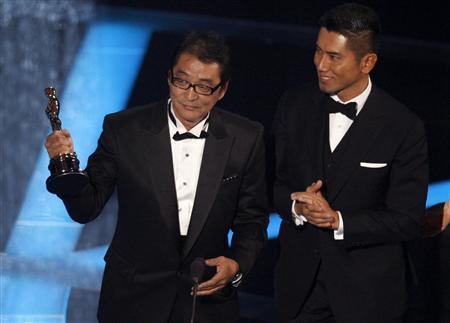
The only real surprise of the night occurred in the wonderfully strong Best Foreign Film category, as Departures from Japan beat out an outstanding Waltz With Bashir and utterly superb The Class (read my review here); I was certain that Waltz would have won despite my greater affinity for The Class, but this huge upset launched Departures to the top of my must-see list.

All in all, the Oscars was a terrific show despite the relatively weak films honored there. What did you all think of the ceremony and winners? Hit me up in the comments. Here's hoping that next year's best films prove better than these.

Photos Courtesy of The New York Times

Read More...

Sunday, February 22, 2009

Strombolian Films

I want to share a terrific post from Girish Shambu, whose blog Girish is a consistently excellent place for intelligent and accessible writing about film, about movies that defy easy understanding. Check it out:


I'm curious to hear about your experiences with films that you weren't ready for when you first encountered them--films that required considerable effort before you could understand and love them. Nicole Brenez calls these Strombolian films; for her, Roberto Rossellini's Stromboli (1949) was such a work. She writes in Movie Mutations: "These are films that resist, that one must surmount just as Ingrid Bergman scaled her volcano, and that change you forever..."

Wong Kar-wai's Chungking Express (1994) was, for me, a key Strombolian film. The first time I watched it, I remember this: I reached for a pillow and hurled it at the screen! It was at the very moment that Faye Wong put on the Mamas and the Papas' "California Dreamin'" for the umpteenth time. The film seemed to be caught in an infinite loop, uninterested in moving forward. At the time I had been discovering the pleasures of character-driven cinema--like Howard Hawks and Eric Rohmer--and in comparison, Wong's film seemed to care not a whit about 'advancing' plot or character. The reigning mood was one of stasis.

A few years later, when I revisited the film, I was led to an important self-realization: that I had privileged and held as 'natural' a certain economy between form and content in a film work. According to this economy, matters of form and style--composition, cutting, rhythm, color, texture, movement, mood--had a specific function. They served something 'higher': narrative and character. Of course, this classicist criterion for judging an artwork seems embarrassingly restrictive to me today--but there was a time when I applied its yardstick to every film that came along. In fact, I suspect that such an economy between form and content is widely held as the norm by the viewing public at large today.

The content of Chungking Express might be about stasis, but its form--I realized upon second viewing--is all about movement! The film burns with stylistic bravura, most remarkably Wong's signature stretch printing of action which smears colors and shapes voluptuously across the screen. The French critic Jean-Marc Lalanne has written:

"In cutting and recomposition through editing each movement of the actors, the mise-en-scène invents a kind of 'ballet mécanique' of human movements, a choreography in which each gesture becomes abstract, loses its functionality in favor of a purely musical value."

Brenez's notion of Strombolian films holds at least three lessons: (1) A viewing experience is often contingent upon where we happen to be situated--in our lives at a certain point in time--in relation to a work and its aesthetic; (2) It is important to revisit films that frustrated or disappointed us the first time around, and do so with a willingness--even eagerness--to struggle with the work while we simultaneously de-emphasize evaluative judgment for a little while; and (3) The resistance we encounter from an artwork can be put to great and productive use.

I'm wondering: What are your experiences of films that you weren't ready for when you first encountered them? Please feel free to share.

You can read the original post on Girish's blog here.

Read More...

Friday, February 20, 2009

Film Comment Selects Opening Night

Hey movie lovers! I've been working at the Film Society of Lincoln Center for a little while now, and they've just sent me an invite that they'd like my friends (read: YOU) to get! It's the opening night of their latest series, the Film Comment Selects, which is TONIGHT. You should come, and definitely check out the rest of this cool series of little-known films selected by the wise people at Film Comment.

Film Comments Selects
Friday, February 20th, 2009
6:30pm Screening of Paradise
8:00pm Talkback with Director Michael Almereyda
& Author Jonathan Letham

Afterparty to follow
The Walter Reade Theater
165 West 65th Street

Please RSVP to Rob Mooney at rmooney@filmlinc.com if you would like to attend.

PARADISE

Michael Almereyda is best known for his hip, update of HAMLET, with Ethan Hawke, and his black-and-white vampire film NADJA. PARADISE continues his recent foray into documentary that began with WILLIAM EGGLESTON IN THE REAL WORLD. Like all of Almereyda's films, PARADISE is a lyrical, melancholy journey that reflects on the nature of creativity, and on what it means to be beautiful or exceptional in the world. It is an intricately arranged journal of Almereyda's own travels. Each section of the film (none longer than a few minutes) is introduced by the name of the city where the action takes place. In long uninterrupted takes, Almereyda introduces us to acquaintances, friends, children of friends and total strangers as they do everyday tasks: flying planes, watching birds, performing music, conducting funeral services. Some of these people are marginal and eccentric. Some, like Kim Gordon of Sonic Youth and Elina Löwensohn, are performers associated with Almereyda's previous work. Towards the end, we see one of the most admired and reclusive directors in the world at his everyday job of making films. Working in the diary tradition associated with Chris Marker and Jonas Mekas, Almereyda has constructed a synthesis of documentary reality and poetic atmosphere.

Read More...

Tuesday, February 17, 2009

Spotlight: The Class

Hey movie lovers! I'm back from a brief hiatus to demand that you go see The Class at Angelika before it's too late. This movie is a truly rare wonder, so full of vitality and pure cinematic vision that it would be criminal to miss.

François Bégaudeau plays himself in this screen incarnation of his book Entre Les Murs, written about his experiences as a schoolteacher in a rough Parisian neighborhood. We follow him and his students--themselves played by real teenagers--through the ups and downs during one year at an ethnically diverse school in a country still plagued by very real racist sentiments. We become immersed in the world of the classroom and the teacher's lounge alike and, by virtue of Bégaudeau's writing and Laurent Cantet's eminently capable direction, experience their distinct pleasures and difficulties with an open-mindedness so consistent that these disparate worlds merge into a unified whole rarely seen onscreen or anywhere at all.

That The Class is not a documentary observation of real events witnessed on camera is nothing short of miraculous. Bégaudeau's moments of pure enthusiasm in his teaching, the sometimes heated exchanges between him and his students, and the dramas unfolding in and out of the classroom are so spontaneous and genuine--and Cantet's filmmaking so wonderfully transparent--that we have the sensation of watching quietly from the back of the room. The teenage students bring character and flair to their roles that are at once entertaining and unsettling, as they evoke a sense of what it feels like to be fourteen in the twenty-first century. François is remarkable as himself, and creates no illusions about his sincere desire to teach or the palpable frustration that must come with that passion.

The effortless realism of the characters makes their struggles all the more fascinating, and it is in these difficult situations that the movie transcends its fiction. A student with an attitude problem sinks further into trouble, François and his fellow teachers grapple with the difficulties inherent in student discipline, the home lives of children spill over into school, and the tensions between them all come to a head; in these and other crises of daily life The Class addresses the fundamental issues of education in a way that is nothing if not global and incisive. And all the while, the movie reveals the sins and the virtues of students and teachers with an equally objective precision that is truly shocking; during the final thirty minutes I had to completely reevaluate my frustration with the students and sympathy for their teacher, and could not have been more thrilled for it. 

In describing this movie to friends, I have told them that it is the single most honest, true-to-life, relevant, and important movie I can recall seeing, and I stand by that statement. The Class is a reminder of what the very best movies achieve: they hold a mirror to reality, grab onto you with memorable characters you can't forget, and force you to reevaluate the things that are right in front of you. If you see a movie in the near future, see The Class while it's still on the big screen, and be glad that you have had the chance.

Read More...

Saturday, February 7, 2009

Movie Club 3: 'The Class'

For our third meeting, we will be watching The Class (Entre Les Murs), winner of the Palme d'Or at Cannes last year and nominee for a 2009 Academy Award for Best Foreign Film. This story of a teacher working with students from a rough Parisian neighborhood is bound to be a great movie, so don't miss it!

What: The Class (Entre Les Murs)
Where: Angelika Film Center (18 W. Houston St. at Mercer) [Map]
When: Tuesday, February 10th at 7:15 PM (7:25 Screening) [Tickets]

I won't be able to attend the screening this week, but I'll be at the theater following the show and we can go from there.

Please RSVP to the Facebook event invitation if you plan to attend. I hope you can make it, and look forward to seeing you all! If you're a member but haven't attended yet (you know who you are), we want to see you!

Check out the trailer for the movie:


Read More...

Friday, February 6, 2009

Spotlight: Doubt

It is a sad fact that a priest and a youngster raised in religion can no longer coexist without the near-certain suspicion of today's society. Stories of sexual abuses perpetrated by Catholic clergymen have shocked the world by exposing a very real flaw in an institution depended on by millions for moral guidance and spiritual strength. Doubt, adapted from the successful Broadway play and directed by its playwright John Patrick Shanley, at once preys on the cultural suspicion aroused by these crimes and challenges the virtue of that blind distrust. This parable of Father Flynn (Philip Seymour Hoffman) and Sister Aloysius (Meryl Streep), the authoritarian principal who suspects him, thrives on the tension between these opposing points of view as much as on the determined performances of its key players. But the film succeeds most strikingly as a window into the conflicting cultures of men and women in a religious community struggling to adapt to a more secular age.


Set in Brooklyn in 1964, the central controversy of the story surrounds the relationship between Flynn and a young boy who struggles to find his way as the first black student at St. Nicholas parochial school. Sister Aloysius, a strict disciplinarian who monitors her students with an aim " to outshine the fox in cleverness", plants the seed of doubt in the mind of Sister James (Amy Adams), an enthusiastic and caring younger nun. Her misgivings about Flynn come to fruition when Sister James reports on his questionable interactions with the boy, and the movie's web of intrigue is set.

While Flynn fervently defends his innocence against the ruthless certainty of Sister Aloysius, the dramatic differences between the lives of priests and nuns reveal the polarizing effects of modernity on a church founded on a firm dedication to devout propriety. The aging women of St. Nicholas live the simple, virtuous lives that generations of nuns lived before them. With Sister Aloysius perched watchfully at the head of the table, they eat their meals and drink their milk  together in near silence, only speaking when she invites them to. These women are even forced to renounce their names upon entering the clergy, instead assuming those of the male saints revered in their patriarchal community. 

Sister Aloysius, played in a wonderfully loathsome turn from Ms. Streep,  represents the archetype of classic Catholic conservatism. Armed with a dedication to her religious tradition and a righteous faith she mistakes for moral certainty, Aloysius defies the changes of the outside world and molds her fellow women into the firm leaders she expects members of the clergy to be.

Of all of the nuns, Sister James in particular struggles with the old-fashioned code of conduct she is expected to live by; she genuinely cares for her students but cannot breach an unspoken student-teacher to offer them any support or guidance they might need. Under the supervision of Sister Aloysius, she learns to spy on students using the glass-framed portrait of a pope while she writes on the chalkboard, and somewhat hesitantly emulates her strict control of the classroom. At one critical moment, she snaps at a student for speaking out of turn, only to be overwhelmed by intense feelings of guilt. Ms. Adams skillfully expresses the conflict of parochial obligations with her own innocent goodwill, here and throughout.

In contrast with the stoic culture of nuns, the priests of St. Nicholas live much more comfortable lives. Their meals, shared over cigarettes and beers, are loud and lively, full of jokes and masculine banter. They are younger, more vital, and are more willing to forgive and understand than to punish and suspect. Where Sister Aloysius marks the pinnacle of conservatism, Father Flynn happily embraces change in the relationship of the church with the outside world. He believes in establishing a more familial quality in interactions with churchgoers and students, and seeks to act as a mentor and friend to his parishioners. 

Unlike Sister James, Flynn seizes opportunities to guide his male students through adolescence, mixing lessons on personal hygiene and proper free-throw technique on the basketball court and sharing insights into the strange new world of girls and school dances. Hoffman lends a warm face and glowing spirit to this new sense of community he hopes for in the church, making his argument for compassion all the more compelling. Sadly, it is this compassion that leads him to take young Donald Miller under his wing and face the damning suspicion of Sister Aloysius.

The tension between Flynn and Aloysius smolders onscreen as personal convictions about religious identity collide.  Perhaps the clearest statement of their antagonism appears in a clever sequence early in the film. Aloysius, framed in a low angle close-up at her desk, looks down coldly to off-screen left; a cut to a medium shot looks down on Flynn in a stairwell, who seems to return her gaze looking upward with an expression of reverent meditation. We expect the next shot to complete the eyeline match between the two, but instead of Aloysius' face, we see the golden glow of a stained-glass window featuring a heavenly image of the Virgin Mary. 

The order of this sequence seems to demonstrate the fundamental difference in perspective between Aloysius and Flynn: where she glares downward with suspicion upon her fellow man, he gazes upward to the heavens with warmth and kindness. This fundamental difference in tone influences the film's perspective (and inclines the viewer to ally with Flynn in my opinion), and makes the opposition between the two all the more compelling.

Read More...

Wednesday, February 4, 2009

Woody Allen Double Header

Fans of New York movie hero Woody Allen will be pleased to learn that Manhattan (1979) and Annie Hall (1977) will be screening back-to-back next Monday February 9th at hipster haven and all-around cool gallery Le Poisson Rouge. The best part? You can get in to see both of Allen's early masterworks for free. So head down to Bleecker Street, get yourself a drink, and enjoy two of New York's greatest movies. Click here for more info.

Read More...

Sunday, January 25, 2009

The Auteurs

I love the internet. Today I happened across The Auteurs, an flat-out amazing website from the brilliant people behind DVD giant The Criterion Collection. This online movie service has a large library of terrific movies available to watch instantly for a few dollars a pop. I'm currently watching Branded To Kill (Seijun Suzuki, 1967), which is cool as hell, and the video quality is pristine. 


Aside from the wealth of great movies on tap, the site encourages discussion among friends and other movie lovers about all things cinematic, which is of course what this club is all about. You can connect with other movie buffs on Facebook, exchange ideas using their online forum, and more. I would definitely recommend that you check out this incredible new site.

Read More...

Wrap Up: Waltz With Bashir

Hello movie lovers! The second meeting of our little group was, in my opinion, even more fun than the first. Attendance for the screening nearly doubled from the first one, Waltz With Bashir was incredible, our libation manager Stu took us to a very cool little bar, and the discussion was very stimulating. Thanks so much to all who came!


Now for the wrap up. Not much to report on the clerical front, so I'll dive in to discussion topics.

  • We discussed the interplay between subjective memory and documentary objectivity in the film, and agreed that the combination of fact, fantasy, and incomplete memory made for a compelling look into the mindset of the soldier both during and after combat. They also made for an interesting story, as Ari's journey to remember the past becomes ours as well.
  • We spent a good deal of time discussing the visual style of the film, from the simple fact of its animation to the specific look and feel of the drawings. We agreed that the animation effectively reframed the images of wartime that are now ubiquitous at the cinema, allowing us to think about war and the protagonist's experiences in a new way. The visual style also sets up some incredibly powerful images in the closing moments of the movie (I won't spoil the moment by telling you anything more). We liked the style of the animation, and found that it was very effective in rendering the movie's alternately brutal and surreal imagery.
  • Bobby made a big splash in his first meeting, dropping some serious historical knowledge about the events surrounding the Lebanon War and the Sabra and Shatila Massacre of 1982. I for one was glad to know more about the events behind this incredible movie, and am officially a more knowledgeable person on world history. Thanks Bobby.
I think that about covers it. I also would like to pose a question I forgot to ask in the meeting: what is your feeling about the fact that Ari's memory of his past does not seem fully resolved by the conclusion of the movie? I thought it made an effective statement that the mind protects itself from traumatic experience by veiling it in mysterious ways, such that the memory cannot fully restore the experience of the past. Write a comment and share your take on this!

Thanks again for attending! Save the date: our next meeting will be on Tuesday, February 3rd around 8pm. Start sending your picks now! There are also plans afoot to watch Persepolis this week, stay tuned for updates.

Read More...

Monday, January 19, 2009

The 11 Best Movie Posters of 2008

Attached to a medium defined by motion and sound, I am amazed by the power that movie posters have in representing films as still images. Some of the most successful posters are as memorable for me as the movies they promote, and often evoke powerful memories of my viewing experience long after I leave the theater. With that in mind, I thought I would share some of what are in my mind the most striking and well-executed movie posters of 2008. I couldn't pick just 10, so I thought I'd turn my speakers up to 11.

11. Waltz With Bashir
I love the color contrast of this image, as well as the piercing gaze of its central figure. The fires falling from the sky, the machine gun held clear of the water, and the gaunt men watching a scene we do not see make this poster very compelling for me. I can't wait to see this tonight! Click here for more information about the meeting.

10. Kabluey
This image is just funny, plain and simple. How can you not laugh at a depressed blue blob staring at its feet on the side of the road? The color contrast is really powerful here too; the orange tones that so nicely evoke a remote country feel make the blue cartoony figure really pop off the page.

9. The Eye
I think I would have ranked this higher if I didn't find it so utterly creepy. However, I think it is the most graphically sophisticated in terms of its execution, as the fingers emerging from the eye are so convincingly integrated into the image.

8. The Memory Thief
I know absolutely nothing about this movie, and yet I very much want to see it. This is a straightforward case of dazzling graphic design. The contrast of yellow details against a mainly black-and-white composition communicates a great deal of information about the movie, and presumably the spread of World War II history over the internet and digital media. 

7. Choke
A cool color scheme and provocative imagery make this movie seem very appealing indeed.

6. Gran Torino
This poster is all about Eastwood. Nothing more, nothing less. How can you pass on a movie with this guy's iconic profile on the cover? The answer is you can't. The lighting is also incredibly striking, and reduces his face to a mere sliver. Very cool.

5. The Dark Knight
The print campaign for this movie was staggering in its scale and diversity of imagery; the collage styling, Joker scribbles, and menacing bloody smile make this poster my favorite of the bunch.

4. Water Lilies
The expressions on the faces of these young girls communicate a growing and unembarrassed maturity with a splash of irreverent indecency. I love the way the colorful tendrils divide the two girls and weave their way around the almost lustful eye of the girl on the right. This poster stands out in my mind for the brilliant simplicity of its composition and its eye-catching colors.

3. Ballast
I want to know everything about this boy. His angelic expression mingles a deep melancholy with a plea for help that really draws me in to this movie. I love the way his face fills the whole image, and how the title leaps out of the deep black shadows in this stark color scheme.

2. Man On Wire
Composition is again the name of the game, as it communicates the vastness of the space occupied by a solitary wire walker in an image as iconic as the buildings it depicts. I love the soft blue light of early morning in this picture, and the way it imbues a dreamlike quality to the image. A beautiful photograph in any context. I also like the choice of such a short and sweet critical response and its appropriateness for the image.

1. Funny Games
I've just realized how prominently human faces have featured in this list, and should say without a doubt that this is by far the most striking. It evokes an incredibly specific tone not of sadness but rather of wholly exhausted terror. The texture of the photograph seems to have been softened slightly, giving it a painterly quality and a classic feel. I think the placement of the text is very intelligent, and love the weight of the bottomless black looming at the top of the page. I need to see this movie.

What posters made an impact on you in 2008?

Read More...

SLG Meeting Two: Waltz With Bashir

For our second meeting, we will watch the critically acclaimed animated documentary Waltz With Bashir, a story of Israeli soldiers during a war with Lebanon in the 1980s. Here are the details for tomorrow's screening:


What: Waltz With Bashir (Ari Folman, 2008)
Where: Sunshine Cinema (143 E. Houston betw. 3rd and 2nd) [Map] 
When: Tuesday, January 20th at 7:50 PM (8:00 Screening) [Tickets]

As we did last time, let's meet in the lobby. Tickets were sold out for The Wrestler at our last meeting, so it might be worthwhile to buy tickets in advance, but I don't expect any issues. We will pick our watering hole/meeting location after the screening, so if you're coming late give me a call. You should have my number.

No one has yet volunteered to be discussion leader this week. Any takers? I'm happy to lead again but would be happy to hand over the reins. Get at me if you're interested.

I will send a Facebook event invite for this meeting; please RSVP so I have an idea of who will be coming. I hope you can make it, and look forward to seeing you! Here is a trailer for the movie:

Read More...

Thursday, January 15, 2009

Pork rind? Pork rind.

I am compelled to inform you of an incredibly significant event in the New York movie scene. The live action classic Teenage Mutant Ninja Turtles will be screening this Friday night as part of the Sunshine Cinema's midnight movie series.

There are no words to describe my excitement. Buy your ticket here and meet me there. I'm bringing my nunchucks.

Read More...

Tuesday, January 13, 2009

Coming Attractions At IFC

I love checking my snail mail and finding new programs from my favorite movie theaters. Today's mailing gave me a reason to look forward to coming months at IFC, where a great lineup of recent releases will appear. Here are some movies that are getting me excited:

Che (Steven Soderbergh, 2008; Now Showing)
This 4.5 hour epic (shown in two parts) is getting a lot of attention from critics and fans alike. I look forward to seeing Benicio Del Toro playing the iconic revolutionary, although I am decidedly not excited about the running time. [Trailer]

Eraserhead (David Lynch, 1977; Showing 1/16-1/18/09)
I confess with great sadness that I have never seen a David Lynch movie, and I intend to remedy the situation by catching his first feature on the big screen. To be honest, I know very little about both the movie and its director, but I look forward to what promises to be a very weird and totally unique experience. [Trailer]

Crips and Bloods: Made In America (Stacy Peralta, 2008; Showing 1/23-2/5/09)
Legendary skateboarder-turned-documentarian has turned in two terrific films already (the outstanding Dogtown and Z-Boys and Riding Giants) and I'm sure his latest will not buck the trend. I expect this to be a compelling look into one of the most notorious subcultures of recent American history. [Trailer]

2009 Academy Award-Nominated Short Films (Showing 2/6-2/19/09)
If you're like me, you make your picks for the short film categories on your Oscar night ballot based on how cool they sound. This year, I'm really excited to get a chance to see the shorts that are always overshadowed by the big movies at Hollywood's self-congratulation party. This should be really cool. The lineup of shorts will be released after they are announced on January 22nd.

Gomorrah (Matteo Garone, 2008; Opens 2/13/09)
My favorite film critic, New York Times writer A.O. Scott (or as one blogger has hilariously dubbed him, Ayo! Scott), called this 'the best movie I've seen at [Cannes]... a furious and brilliant engagement with the times in which we live.' (NY Times review) I've heard terrific things about this exploration of Naples' criminal underworld. Oh, and it won this little award called the Palme D'Or. No big deal. [Trailer]

Tokyo Sonata (Koyoshi Kurosawa, 2008; Showing 3/13-3/26/09)
I had the pleasure of seeing this at the New York Film Festival, and found it to be a disturbing if very moving portrait of a Japanese family well on its way to total collapse. A father deceiving his family after losing his job, a young boy secretly spending his lunch money on piano lessons forbidden by his parents, a Japanese teenager seeking escape by volunteering for the American military--these are the fragments in Kurosawa's vision of the shattered nuclear family in modern Japan. [Trailer]

Hunger (Steve McQueen, 2008; Screening 3/20-4/2/09)
This story of protesters during the 1981 Irish hunger strike met with great acclaim upon its release at Cannes this year, where it won the prestigious Caméra D'Or as the best first film of the festival. Critics say that Michael Fassbender (who played, among others, the guy who wanted to fight in the shade in 300) turns in an astonishing performance as the IRA volunteer Bobby Sands. Definitely looking forward to this one. [Trailer]

For more information about these and other movies on the horizon, check out the IFC website.

Read More...

Wednesday, January 7, 2009

Wrap Up: 'The Wrestler'

Without a doubt, the club's first meeting was a blast, thanks so much to all who attended! We laid the groundwork for future meetings and had a great discussion of The Wrestler over a few beers at the Library. In these 'Wrap-Ups' I'll post some notes about the general topics of conversation, talk about logistics for the next meeting, and maybe throw out some ideas for further discussion. So, with that in mind, here's the rundown from last night's meeting.


Clerical Stuff
  • Decided to meet bi-weekly. The next meeting will be on Tuesday, January 20th around 8pm. Save the date!
  • Agreed to decide which movie to watch one week before the next meeting. Please post your picks for our next movie in the comments by next Tuesday, January 13th.
  • Decided in favor of having a volunteer to lead discussion at each meeting. The next discussion leader has yet to be decided. Anyone interested?
  • Decided to change the name of the club. Please brainstorm and bring your ideas to the next meeting!
Discussion (I will try my best not to spoil anything, but no guarantees)
  • After agreeing that we all generally liked 'The Wrestler', the subject of the movie's ending was the first that we discussed. Some people found it to be a fitting conclusion, given that it glorifies Randy's passion as a wrestler and abstains from showing the potentially disturbing results of his actions. (Vague enough for you?) Others did not.
  • We shared our thoughts regarding the often gratuitous violence and nudity in the movie. We asked how these elements contributed to its overall tone, how (if at all) they contributed to our understanding of Randy and Pam (Cassidy), and if they were overly sensationalized. We decided that they suited the movie's gritty subject matter and drove home the reality of the heavy toll that wrestling and dancing have taken on their aging bodies.
  • Tom made a great point about the parallels between Randy and Pam, arguing that they both made a living by selling their flesh and struggled to come to terms with their age and the binding relationships in their lives.
  • We talked about The Wrestler  in comparison with Aronofsky's other works, particularly with regard to its almost documentary style. We agreed that the gritty, behind-the-scenes feel achieved by the camerawork in this movie was more appropriate than the generally composed and smooth camera work of the director's earlier work.
  • We also discussed the themes of Aronofsky's work that appeared in the movie, particularly his preoccupation with mortality, the need for personal affirmation, and elements of American mythology--in this case, professional wrestling. We wondered how this movie might be received by real fans of the sport, and discussed the insights it offers into the lives of pro wrestlers.
I think we all had a lot of fun talking about the movie. I certainly came away from the conversation with a better understanding of the movie than I had before, which in my mind is the greatest thing about this club. Everybody made great points and contributed so much to the conversation, so thanks again for coming! To those of you who couldn't make it, I hope we'll see you on the 20th!

As a last bonus, here's a link to the song that plays over the closing credits, a beautiful little tune written for the movie by the Boss himself. Enjoy!

Read More...

Monday, January 5, 2009

SLG Inaugural Meeting: 'The Wrestler

At long last, this little group will finally hold its first meeting! I'm very excited. The people have spoken, and picked Darren Aronofsky's latest effort, 'The Wrestler', for our first movie. Here are the details for tomorrow's screening:


What: 'The Wrestler' (Darren Aronofsky, 2008)
Where: Sunshine Cinema (143 E. Houston, betw. 3rd & 2nd) [map]
When: Tuesday, January 6th at 8:10PM (8:20 Screening) [tickets]

Let's plan on meeting in the lobby of the theater. After the show, we will kick up our heels at a local watering hole, discuss the movie, and lay the groundwork for future meetings. The location is TBA, so if you're coming late give me a call. You should have my number.

I hope you can make it! Friends are definitely welcome. If you're not familiar with the movie, check out the trailer!

Read More...